Trans
picture: l.b.
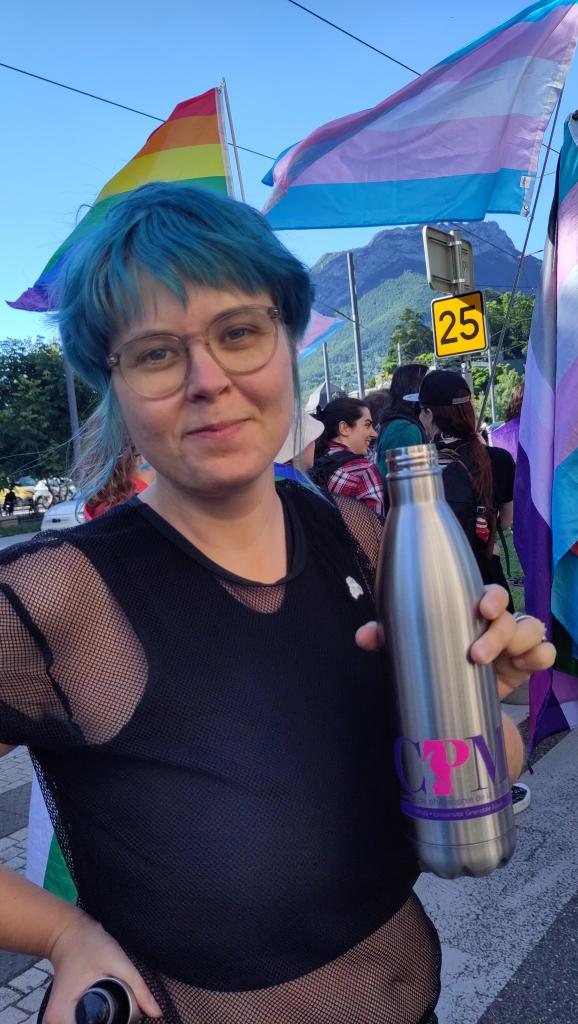
Science is getting unfreer every week in the US, and trans people as well as many others are not safe there. This has been recognized also in an open letter by the American Philosophical Association – signed by Amy Kind, Rebecca Copenhaver and many more. Help trans researchers who want to leave the US and other authoritarian countries find jobs in Europe by joining these groups: https://t.me/+fsGWbLpN0U42ZjVk (Telegram),
https://discord.gg/gBkdnyM3Xp (Discord). Check out options for opportunity hiring at your non-US university now. If you have a say in the organization of a US-located conference, please advocate for a hybrid format – many endangered researchers cannot travel there under the current administration. Don’t make Latin-American and trans people leave or enter the United States for their careers. For some, even travel between its states is unsafe.
I share some of my experiences being a trans (analytic, early career) philosopher in the zine ‘Being trans in philosophy‘, edited by Ding & Willow Starr.
I host the informal mailing list GeTLLI (genderqueer and trans in logic, language and information). Send me an e-mail if you would like to be added to the mailing list.
Stephanie Evert has a good basic introduction to transness on her website. Talia Mae Bettcher’s substack “Into the darkness” rebutes anti-trans arguments philosophically.
I am on the board of Venib, the (I think) biggest Austrian non-binary NGO. I was allegedly (German article) the first endo (non inter*) non-binary person with an X (instead of M or F) marker in their Austrian passport.
Please cite all of my work using my current name, Emil Eva Rosina, E.E. Rosina, or (for older stuff, if needed) E. Rosina. If you wonder what it means that I use they/he pronouns, or why anyone would put things like that in their e-mail signature, here is an explanation: Gender Identity and Pronouns. Comprehensive Guide. Spoiler: Yes, you are allowed to make mistakes. No, the reason why we care is not that we are brainwashed or trying to be annoying.
Autism
left hand: franci mangraviti
Amnesty International, Our collective statement on the death of Professor Jason Arday, 18 Aug. 2026: “Jason [Arday] was a scholar, teacher, colleague, friend and family member. He was also a Black autistic man whose journey expanded our imaginations and understanding of what we believed possible in academia. For racialised, Black, disabled and neurodivergent people, particularly those who have been told that our bodies, minds, origins or differences disqualify us from belonging, his achievements represented hope.
This loss is therefore not only personal to those who knew and loved him. Its shockwaves are collective, travelling across academic, Black, disabled and neurodivergent communities, and more, beyond the UK. We grieve the person he was, the care and possibility he offered others, and all he might yet have done.
Black Disabled Lives Matter; accountability, academic integrity and rigorous scrutiny matter. Accountability measures must be applied fairly, proportionately and in accordance with due process. But accountability cannot become a licence for dehumanisation. […] Professor Arday was a victim of a brutal, racist witch hunt that continued on even after he resigned from his post and made clear that he wanted to step away from public life. […] Professor Arday is not the first victim of our toxic, unregulated media culture and unless there is systemic legislative change, he won’t be the last […].
Universities must also examine their existing frameworks and how they recruit, support and protect colleagues who are celebrated as evidence of inclusion yet left exposed when scrutiny occurs. Representation without care is not equity; it is tokenism at best and extractive and a form of violence at worst. Inclusion without structural protection is conditional access.”
My series of talks on the inclusion of autistic people like myself in academic structures is continuing: I have been invited to give the talk ‘Unmasking neurodiverse academia (and surviving it)’ at the RMU Weeks of Equal Opportunities (Goethe University Frankfurt) on November 3rd. (Details for joining online will follow.)
I gave a course on neurodivergence in academic and medical contexts at the ‘Vernetzungstreffen der Kritischen Medizin’ on Nov. 23rd 2025 in Cologne; and an online Lunchtalk titled ‘Performing productivity and performing neurotype – autistic masking in university contexts’ on Oct. 27th 2025 (invited by UNIFY, University of Heidelberg).
Maja Hoffmann wrote an article (in German) about my 2024 talk ‘Autistisch sein und Versagen in der akademischen Welt’ (organized by Campus Neurodivers RUB) in the BSZ that can be accessed here.
Outreach
legs: d.f.

In 2024 and 2025, I gave career+outreach presentations to high school students gendered as girls as a part of the SFB 1315’s “Girlsday”.
An easy description of my PhD work for non-linguists can be found in this article by Meike Drießen in the Rubin magazine.
I’m a first generation university student, and I like to say that I think this has influenced my position and struggles in academia even more than my transness and neurodivergence. But, of course, causality is never easy. Still, I don’t know how to pinpoint these struggles in words that would not themselves, by being academic language, feel like a betrayal of my roots of some sort. Because of classism, the only language I speak fluently these days feels alien to me at times.
Snippets of my past
picture: valeria gradimondo
My linguistic MA thesis (supervision: Viola Schmitt) introduces and partially solves a puzzle on conversational backgrounds of good-predications. It can be accessed here. It has lead to a talk and many notes/manuscrips on possible hierarchies of Kratzerian Ordering Sources, but I still consider much of this project open.
I also have a high school teaching degree and have taught German as a native, second, and foreign language. The narratological MA-equivalent thesis of my teaching degree (supervision: Wynfrid Kriegleder) was about metafictionality and can be found here (in German language, English abstract available).
I owe a lot of my philosophical background to the Vienna Forum for Analytic Philosophy and their easy-access opportunities for presenting ideas and work in progress.

